
Blackhead Removal: Pore Strips vs. Salicylic Acid vs. HydraFacial
Blackheads: What Actually Works? Pore Strips vs. Salicylic Acid vs. HydraFacial
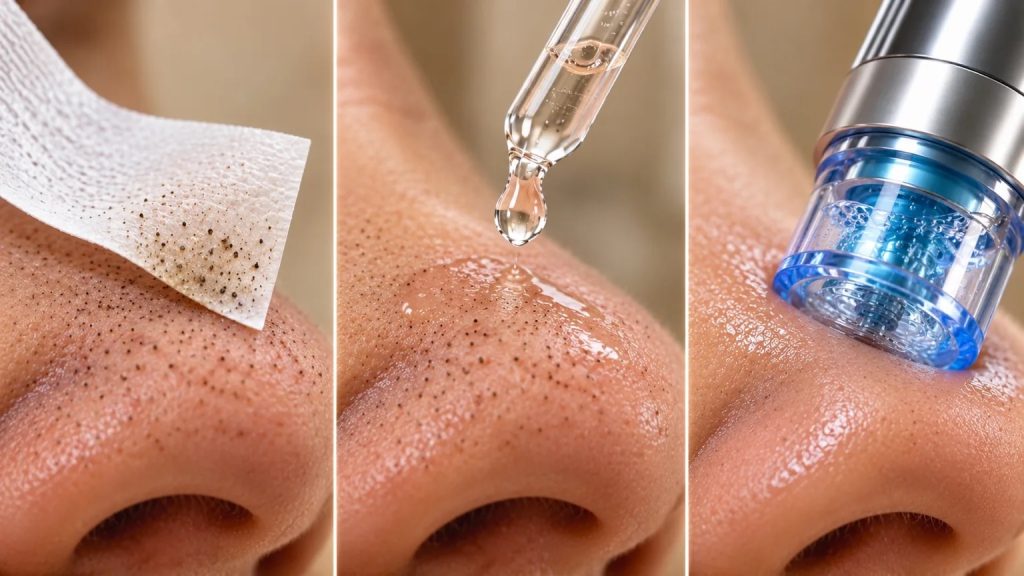
A practical guide to understanding clogged pores, choosing the right treatment, and keeping your skin clearer over time.
Blackheads can be frustrating. You remove them, your skin looks clearer, and a few weeks later, those tiny dark dots are back.
So, what actually works?
Pore strips, salicylic acid, and HydraFacial treatments all approach blackheads differently. Understanding those differences can help you choose a treatment that makes sense for your skin.
First, What Is a Blackhead?
A blackhead, medically known as an open comedone, develops when excess sebum (skin oil) and dead skin cells accumulate inside a hair follicle.
When the material at the opening is exposed to air, oxidation contributes to its dark appearance.
Blackheads are not simply dirt trapped in your skin.
They commonly appear on the nose, chin, forehead, and other oil-prone areas.
And here’s something important: not every tiny dark dot on your nose is a blackhead. Some are sebaceous filaments—normal structures that help move oil to the skin’s surface.
Pore strips use adhesive to grip material at the skin’s surface.
1. Pore Strips: The Quick Surface Fix
When removed, they may lift some visible blackheads, oil, dead skin cells, and sebaceous filaments.
What they do well
They can provide an immediate, temporary improvement in the appearance of congested pores.
What they don’t do
Pore strips do not regulate oil production or prevent new blackheads from forming.
They may remove only part of a blockage, although the amount removed varies.
Repeated or aggressive use can also irritate the skin.
Best takeaway: Pore strips may offer a temporary cosmetic improvement, but they are not a long-term blackhead-management strategy.
2. Salicylic Acid: The Gradual Pore-Clearing Ingredient
Salicylic acid is a beta-hydroxy acid (BHA) commonly used in acne skincare.
It helps exfoliate dead skin cells and reduce the buildup that contributes to clogged pores.
Unlike a pore strip, salicylic acid does not physically pull a blackhead out.
Its benefits develop through consistent use over time.
Why people use it
Salicylic acid may help:
- Reduce clogged pores and blackheads
- Improve the appearance of rough or congested skin
- Limit the buildup of dead skin cells
- Support a more consistent skincare routine
How quickly does it work?
Not in seconds.
Visible improvement generally requires repeated use over several weeks, and results depend on the formulation, frequency of use, and individual skin response.
Start cautiously and follow product directions, especially if your skin is sensitive or you already use other exfoliating ingredients.
Best takeaway: Salicylic acid is a useful option for ongoing blackhead management rather than instant extraction.
3. HydraFacial: Fluid-Assisted Cleansing and Extraction
HydraFacial combines cleansing, exfoliation, fluid delivery, and controlled suction in a professional treatment.
Its Vortex-Fusion technology uses a specially designed treatment tip to help loosen and remove surface debris while delivering treatment solutions.
What makes it different?
Rather than relying on adhesive or a leave-on exfoliant alone, HydraFacial uses a combination of liquid movement, exfoliation, and suction.
This may help reduce visible congestion and improve the appearance and feel of the skin after a treatment.
Does HydraFacial remove every blackhead?
Not necessarily.
Some accessible debris may be extracted during a session, but deeper or persistent comedones can remain.
Results vary with skin type, the nature of the congestion, and the treatment performed.
HydraFacial also does not permanently stop blackheads from returning.
Best takeaway: HydraFacial can be an option for professional cleansing and extraction, particularly when combined with appropriate ongoing skincare.
Which Treatment Should You Choose?
| Your goal | Option to consider |
| A quick, temporary cosmetic improvement | Pore strip |
| Ongoing management of clogged pores | Salicylic acid |
| Professional cleansing and fluid-assisted extraction | HydraFacial |
| Persistent or recurrent comedonal acne | Dermatology assessment and an individualized treatment plan |
The most suitable choice depends on your skin—not just the number of blackheads you can see.
5 Habits That Can Help Reduce Blackheads
1. Cleanse gently. Use a mild cleanser and avoid aggressive scrubbing.
2. Choose non-comedogenic products. Look for moisturizers and makeup formulated not to clog pores.
3. Be consistent with your skincare. Treatments such as salicylic acid require time.
4. Avoid aggressive squeezing. Picking or forceful extraction can cause irritation, inflammation, or scarring.
5. Protect your skin barrier. Use an appropriate moisturizer and daily broad-spectrum sunscreen.
If blackheads are persistent, or you also have inflamed, painful, or scarring acne, consult a dermatologist. Treatments such as topical retinoids may be more appropriate for some people.
The Bottom Line
There is no single treatment that works best for everyone.
Pore strips offer temporary surface removal.
Salicylic acid helps manage the buildup that contributes to clogged pores over time.
HydraFacial offers professional fluid-assisted cleansing and extraction.
The goal isn’t simply to empty a pore once. It’s to develop a routine that helps manage congestion without unnecessarily irritating your skin.
Explore Professional Skincare in North Vancouver
At Leily Beauty & Wellness Clinic, we believe skincare should begin with understanding your skin and its needs.
Interested in professional facial treatments or discussing your skin concerns?
Contact Leily Beauty & Wellness Clinic
125–2030 Marine Drive
North Vancouver, BC
Phone: 236-330-8852
Website: leilybeautyclinic.com
Instagram: @leilybeauty.clinic
Educational information only. Results vary. This article is not a substitute for individualized medical advice.